New York Muscat Grapevine
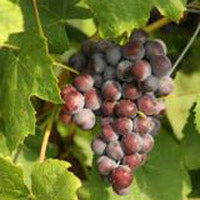
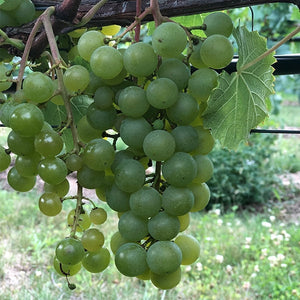
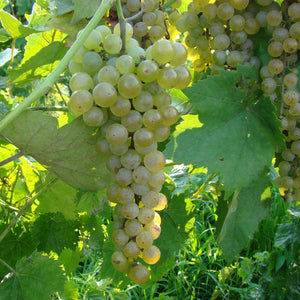
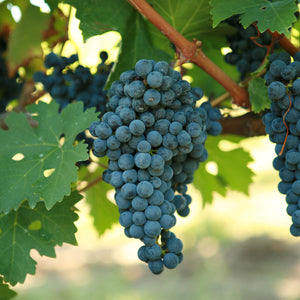
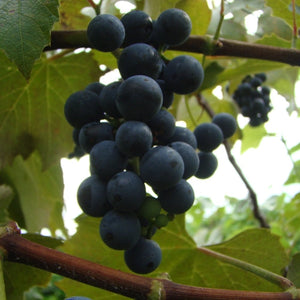
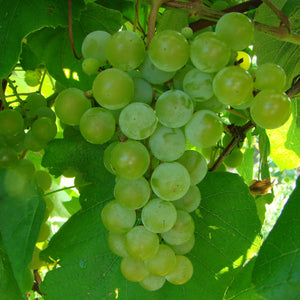
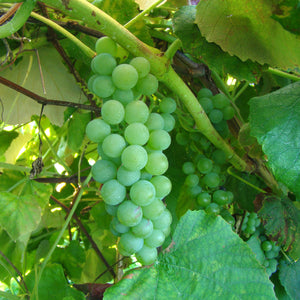
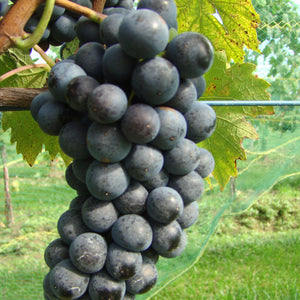
New York Muscat produces reddish-black fruit with fine muscat flavor. Used for sweet muscat wines and as a dosage in champagne, its largest drawback is lack of winter hardiness.
Merlot is Bourdeaux's most planted grape variety, known for its smooth texture and outstanding varietal wines, but often blended with Cabernet Sauvignon. Earlier ripening than Cabernet Sauvignon, but not as winter hardy.
Viognier is a Rhone variety that produces small clusters of yellow and amber fruit. Viognier can make excellent wines with distinctive aromatic characteristics, but vines tend to have low vigor and produce relatively small crops.
A sister seedling of La Crosse, St. Pepin typically produces fruit with low acidity and is used for German style white wines and for ice wine. Not self-pollinated so must be planted near another variety that blooms at the same time.
A full sibling of Himrod, Lakemont has milder flavor and more compact clusters with fairly small berries. Not as winter hardy as Himrod.
The standard of white wine grapes, Chardonnay can be used to make a wide range of wine styles from "fruit forward" wines fermented in stainless, to buttery wines fermented or finished with oak. Chardonnay is the primary variety in Burgundy and California and is one of the components of traditiona...
This variety is suited for making dry white wines. The grape bunches are loose which can contribute to reduced disease. Clarion ripens earlier than many riparia based wine varieties. Tasting notes include pear, citrus, melon, apricot and chamomile.
Chardonel is a productive, late-ripening white wine grape with improved winter hardiness over its Chardonnay parent. Can produce an excellent white wine when fruit is mature. Like Chardonnay, wines can be fermented and aged in stainless steel to produce fruit forward wines, or they can be barrel ...
Sabrevois is a sister variety of St. Croix with better winter hardiness. Sugar content is typically low and wines can have pleasant fruitiness lacking in body and tannins, so there is potential for blending with other complimentary red hybrids.
An important variety in Uruguay, Tannat produces deeply colored wines that are astringent and often blended with other varieties such as Cabernet Franc and Cabernet Sauvignon.
Gruner Veltliner is Austria's most widely planted grape and a staple in Eastern Europe, prized for producing dry, spicy, and peppery white wines. This late-ripening variety is well-suited for warmer regions, though it’s sensitive to Black Rot, Downy Mildew, and Powdery Mildew, with moderate susce...
This red wine grape has great blending potential and is highly resistant to Pierce's Disease. It has a mid-season bloom and ripening period and has relatively large berries and loose clusters. It's highly productive. Tasting notes include dark red-purple color, complex fruit with herbs and earth,...
Pinot Noir is the classic red Burgundy cultivar, it ripens best under cool, dry conditions and is best suited for cool but moderate climates. Wines are lower in tannins and pigments than the other great French wine varieties, and are used for red and rosé wines, and are one component of tradition...
Maréchal Foch is an early ripening black grape with small berries and clusters, often susceptible to bird predation. It can be made into a variety of wines ranging from light and fruity to full-bodied.
Blanc du Bois is a Pierce's disease tolerant cultivar with very good wine quality potential. Grown successfully where temperatures do not drop below +10F (USDA hardiness zone 8). Grown in coastal areas in the southeast United States (South Carolina to Texas) and north into the Texas Hill country....
Portugal's version of Albariño which is widely grown in Galacia (northwest Spain). Alvarinho produces distinctive, aromatic, high quality wines. Grown in a humid, maritime climate, it has thick skin making it resistant to bunch rots.
Vidal Blanc is a productive white wine grape with medium-sized berries borne on very large, compact tapering clusters. Vidal can produce a semi-dry varietal wine and is often blended with other white hybrids. Fruit has thick skin and is highly resistant to fruit rots so can be used to make late h...
Developed as a table grape, Edelweiss has medium-sized berries on large loose clusters. Wine is usually finished sweet and has pineapple overtones; fruit should be harvested at 14°- 16° brix to avoid strong Labrusca flavors.
Diamond is one of the few white American varieties that has been used to produce sweet, dry, and sparkling wines. Although largely replaced by Niagara for white grape juice production, Diamond is considered a superior wine variety.
Chelois is a highly ranked French American variety used as a varietal or for blending with other red hybrids. Like many French American hybrids, it may require cluster thinning to prevent overcropping. Chelois combines late budbreak with early ripening, so may be suitable for regions with short s...